

Why Hospital Signage Compliance Matters
Healthcare facilities face complex regulatory requirements when it comes to signage. From accessibility compliance to patient rights notifications, hospital signage requirements must navigate federal, state, and local mandates to ensure their signs meets all legal standards.
Proper signage and hospital sign frames serves multiple critical functions: ensuring accessibility for patients with disabilities, communicating patient rights, protecting public safety during emergencies, and preventing hazardous exposure. Non-compliance can result in significant penalties, legal liability, loss of Medicare/Medicaid funding, and most importantly, compromised patient safety and experience.
Federal Mandates Governing Hospital Signage Requirements
Navigating a healthcare facility can be challenging, making clear and compliant communication essential for patient safety and legal compliance. Federal regulations establish strict standards for hospital signage to ensure that information is accessible to all individuals, regardless of their physical or cognitive abilities. Healthcare providers must adhere to these statutory frameworks to maintain operational certification, avoid costly penalties, and foster an inclusive environment.
Americans with Disabilities Act (ADA) Accessibility Signs
The ADA establishes comprehensive requirements for signage in all public accommodations, including hospitals. These requirements ensure that individuals with disabilities can navigate healthcare facilities independently and safely.
ADA signage requirements apply to all permanent rooms and spaces within a hospital. This includes patient rooms, examination rooms, restrooms, conference rooms, exit doors, stairways, elevators, and areas of refuge. Room numbers, directional information, accessible parking spaces, accessible building entrances, and service locations like cafeterias, pharmacies, gift shops, and chapels must all feature compliant signage.
Technical Requirements for ADA Compliance
ADA-compliant signs must meet specific design and installation standards to ensure accessibility. Characters and symbols must contrast sharply with their background, using either light-on-dark or dark-on-light combinations. Sans-serif fonts are required for all tactile characters to maximize legibility for people with visual impairments. Non-glare surfaces prevent reflection that could obscure information for people with low vision.
Tactile characters must be raised at least 1/32 inch above their background, and Grade 2 Braille must accompany all tactile signs, positioned directly below the corresponding text. Visual characters must be sized appropriately based on viewing distance, with minimum heights specified for different applications. Signs must be installed on the latch side of doors at a height between 48 and 60 inches from the floor to the baseline of the lowest tactile character. A clear 18×18 inch floor space must be provided in front of the sign for approach.
Common hospital signage requirements mistakes include installing signs on the hinge side of doors instead of the latch side, using glossy finishes that create glare, omitting Braille or using incorrect Braille grade, having insufficient color contrast between text and background, and mounting signs at incorrect heights.
Emergency Medical Treatment and Labor Act (EMTALA) Patient Rights Signs
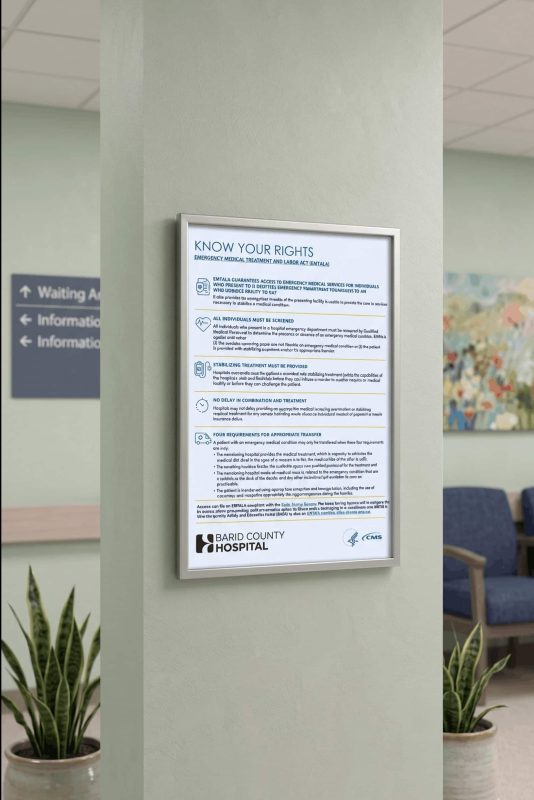 EMTALA, enacted in 1986, requires Medicare-participating hospitals with emergency departments to provide medical screening and stabilizing treatment regardless of a patient’s ability to pay. Proper signage is essential for informing patients of these rights.
Hospitals must conspicuously display signs informing individuals that they have the right to receive an appropriate medical screening examination and are entitled to stabilizing treatment for emergency medical conditions and labor. These services are provided regardless of ability to pay, and the signage must also indicate the hospital’s participation status in Medicaid programs.
Placement and Language Requirements
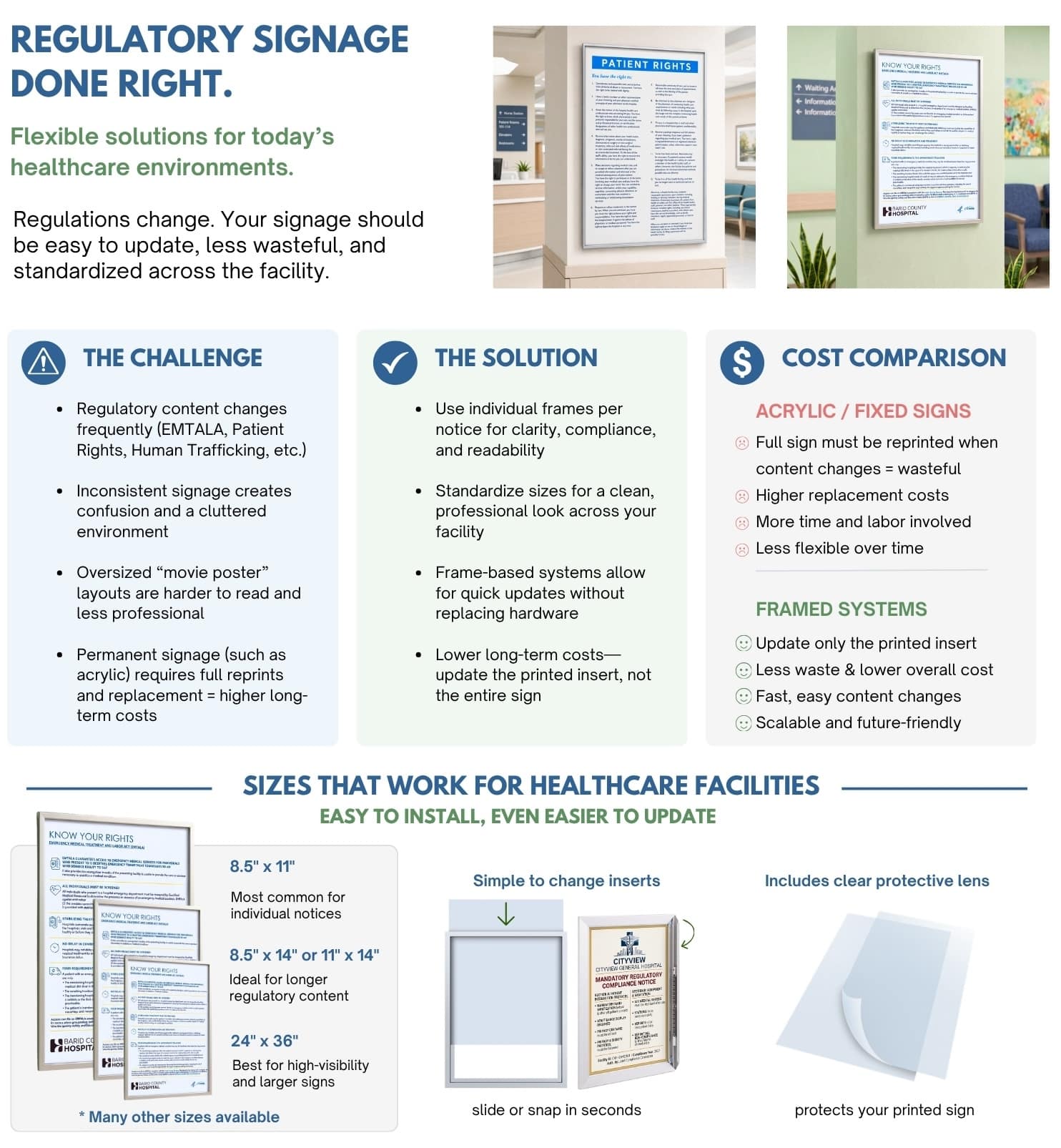
As shown above, most facilities handle EMTALA and similar notices using standardized frame sizes like 8.5″ x 11″ or 8.5″ x 14″ for consistency and readability.
Signs must be posted in locations where patients and family members are likely to see them, including main entrances to the hospital, emergency department entrances, patient waiting rooms and reception areas, admitting and registration areas, and other high-traffic public areas.
The Centers for Medicare & Medicaid Services (CMS) requires that signage be written in clear, understandable language appropriate for the general public and available in languages commonly spoken by the populations served by the hospital. The formatting should allow for easy readability with appropriate font sizes. CMS provides model signage that hospitals can use or adapt to meet local language needs. Facilities should assess their service area demographics to determine which translations are necessary.
View EMTALA sign frame holders.
Fire and Life Safety Code Hospital Signage Requirements
Federal fire and building safety codes, primarily enforced through the National Fire Protection Association (NFPA) Life Safety Code 101 and adopted by state and local jurisdictions, mandate comprehensive emergency signage throughout healthcare facilities.
Emergency signage requirements include clearly marked, illuminated exit signs at all exits, with directional arrows where the exit path is not immediately apparent. Floor plans showing primary and secondary evacuation routes should be posted near elevators and in corridors. Signs directing occupants toward the nearest safe exit must be visible along exit paths.
Fire extinguisher locations need visible identification from a reasonable distance, and manual fire alarm activation points require clear identification. Designated safe areas for individuals unable to use stairs during evacuation must be marked, along with locations where emergency medical supplies are available.
Signs identifying automated external defibrillators (AEDs), emergency oxygen, and other life-saving equipment are also required.
Technical Standards for Emergency Signs
Emergency exit signs must meet specific illumination and visibility hospital signage requirements. They typically require continuous illumination or approved self-luminous materials, backup power sources for electrically powered signs, minimum letter height specifications (usually 6 inches for “EXIT”), red or green color coding as specified by local codes, and photoluminescent options that remain visible during power failures.
Hazard Communication and Occupational Safety Hospital Signage Requirements
Healthcare facilities must comply with OSHA (Occupational Safety and Health Administration) standards for workplace hazard communication, particularly important given the unique risks in hospital environments.
Biohazard warnings are required on doors, containers, refrigerators, and equipment where biological hazards are present, featuring the universal biohazard symbol and orange or orange-red coloring. Nuclear medicine departments, radiology areas, and anywhere radioactive materials are used or stored must display appropriate radiation warning signs in magenta or purple on yellow backgrounds.
Storage areas for hazardous chemicals must be properly labeled with appropriate hazard warnings. Signs indicating where specific personal protective equipment (masks, gloves, gowns, eye protection) must be worn are mandatory in relevant areas. Contact precaution signs, isolation room indicators, and hand hygiene reminders are essential infection control signage.
Employee health and hygiene signs must include “Employees Must Wash Hands” notices in all restrooms and food service areas, hand hygiene compliance reminders at sinks and hand sanitizer stations, proper disposal instructions for contaminated materials, and clean/dirty area designations in sterile processing and surgical areas.
No Smoking Policy Signs
The Pro-Children Act and subsequent federal, state, and local smoke-free laws require most healthcare facilities to maintain smoke-free campuses. Hospitals must post no smoking signs at all building entrances, designated smoking area signs where permitted and at safe distances, prohibition of electronic cigarettes and vaping devices where applicable, and contact information for reporting violations.
State-Specific Requirements
While federal mandates establish baseline hospital signage requirements, many states impose additional signage obligations on hospitals.
California Hospital Signage Requirements
California hospitals face particularly comprehensive signage mandates regulated by multiple state agencies. The Department of Health Care Access and Information (HCAI) requires hospitals to post notices in public areas indicating the building’s seismic performance category and compliance status with state earthquake safety standards.
California law requires posting of the “Patient’s Bill of Rights” in multiple languages, prominently displayed in admission areas, patient rooms, and public spaces. Notices informing patients of free interpreter services must be posted in threshold languages, which are those spoken by substantial portions of the service population.
Examples from Other States
New York requires hospitals to post information about hospital-acquired infection rates. Texas mandates signage regarding patients’ rights to pain management. Massachusetts requires posting of staffing level information. Florida mandates signs regarding advance directives and patient self-determination. Hospital administrators should consult their state health department and hospital association for complete state-specific requirements.
Best Practices for Hospital Signage Compliance
Conducting a Signage Audit
Regular signage audits help identify compliance gaps. Hospitals should inventory all current signage throughout the facility and compare it against federal requirements including ADA, EMTALA, and life safety codes. Reviewing state and local mandates specific to your jurisdiction is essential.
Assessing the condition and visibility of existing signs helps identify issues before they become violations. Once you’ve identified missing or non-compliant signage, prioritize replacements and additions based on regulatory risk and patient impact.
Working with Qualified Signage Vendors
Partner with signage manufacturers and installers who demonstrate expertise in healthcare regulatory requirements and provide ADA-compliant products with proper certifications. They should offer multilingual capabilities appropriate for your patient population and understand healthcare-specific materials requirements such as cleanability and durability. Quality vendors can provide documentation of compliance for regulatory inspections.
Material Selection Considerations
Hospital signage must withstand frequent cleaning with hospital-grade disinfectants while maintaining compliance standards. Consider non-porous materials that don’t harbor pathogens, finishes that resist degradation from cleaning chemicals, durable construction for high-traffic areas, and easy-to-update systems for information that changes regularly.
Maintenance and Updates
Establish protocols for regular inspection of all signage for damage, fading, or obstruction. Prompt replacement of damaged or non-compliant signs prevents regulatory issues. Ensure that signage is updated when regulations change and that new construction and renovations include compliant signage from the start. Training facilities staff on signage requirements and maintenance helps maintain ongoing compliance.
Regulatory Resources and Compliance Support
To ensure your hospital maintains full signage compliance, consult authoritative sources including ADA.gov for official ADA regulations and technical standards for accessible design, CMS.gov for EMTALA requirements and model patient rights signage, OSHA.gov for workplace safety signage requirements and hazard communication standards, and NFPA.org for Life Safety Code 101 and fire safety signage standards.
State resources include state health departments for state-specific hospital licensing requirements, state fire marshal offices for fire and life safety code enforcement, and state hospital associations for compliance guidance and templates. Professional associations like the American Hospital Association (AHA), American Society for Healthcare Engineering (ASHE), and Facility Guidelines Institute (FGI) also provide valuable guidance.
Common Hospital Signage Requirements Questions
How often should hospital signage be updated?
Signage should be inspected regularly and updated immediately when regulations change, when facilities are renovated, or when signs become damaged or illegible. ADA standards and life safety codes don’t change frequently, but patient rights information, infection control protocols, and state requirements may be updated more regularly.
Who is responsible for signage compliance in a hospital?
Responsibility is typically shared among facilities management, compliance officers, risk management, and administration. Clear assignment of accountability and regular cross-departmental communication is essential for maintaining comprehensive compliance.
Can hospitals create their own patient rights signs or must they use official templates?
For EMTALA signage, CMS provides model language that is recommended but not always mandatory. However, the content must accurately convey the required information. Custom designs are acceptable if they meet content and visibility requirements. Always verify with your state health department for any state-specific template requirements.
What are the penalties for signage non-compliance?
Penalties vary by violation type. ADA violations can result in lawsuits and court-ordered compliance. EMTALA violations may lead to civil monetary penalties up to $119,942 per violation and potential exclusion from Medicare. Life safety code violations can result in citations, fines, and in serious cases, threats to hospital licensure.
Do temporary signs need to meet the same standards as permanent signs?
Temporary informational signs such as construction notices or temporary closures don’t need to meet tactile and Braille requirements. However, if a temporary sign identifies a permanent room or space, it must meet ADA standards. Exit signs and emergency signage must always meet life safety requirements regardless of whether they’re considered temporary.
Conclusion
Hospital signage sits at the intersection of compliance, patient safety, and overall experience. While the requirements can feel complex—spanning federal, state, and local regulations—the goal is simple: ensure patients can access care, understand their rights, and navigate your facility with confidence.
The challenge for most hospitals isn’t just knowing the rules—it’s maintaining consistent, up-to-date signage across departments without driving up costs or creating inefficiencies.
Facilities that succeed typically take a more strategic approach:
- Standardizing signage across locations
- Using systems that are easy to update as regulations change
- Conducting regular reviews to avoid compliance gaps
When done right, regulatory signage becomes more than a requirement—it becomes part of a well-run, patient-focused environment.
Regulatory requirements may change. Always consult current federal, state, and local regulations for your specific facility.