
Blog
Healthcare Signage Requirements: ADA, Safety & Wayfinding Guide

Looking for Hospital Campus Signage? This guide covers non-hospital facilities (medical offices, urgent care, surgery centers, and clinics). If you manage a hospital, read our Complete Guide to Mandated Hospital Signage Requirements for EMTALA, safety, and patient rights regulations.
Overview: Nearly every healthcare facility in the U.S. must comply with ADA accessibility signage standards and OSHA workplace posting requirements. Most medical practices also require a visible HIPAA Notice of Privacy Practices. Specific requirements vary by facility type: Ambulatory Surgery Centers follow CMS Conditions for Coverage, nursing homes require resident rights notices, and EMTALA signage generally applies only to qualifying hospital emergency departments.
- ADA Compliance: Room identification and tactile signs are required across almost all healthcare facilities.
- HIPAA Privacy Notices: Must be prominently posted in waiting areas or check-in desks where patients can easily read them.
- OSHA & Biohazard: Mandatory workplace safety posters and biohazard labels apply to clinics, labs, and medical offices.
- Facility Specifics: EMTALA rules generally target hospitals, while CMS regulations apply heavily to ASCs and nursing homes.
- Future-Proofing: Installing updateable insert sign frames dramatically simplifies ongoing compliance changes.
Need compliant frames for your medical office or clinic?
Explore heavy-duty, easy-change hospital sign frames & healthcare sign holders built for high-traffic facilities.
Table of Contents
Why Facilities Have Different Healthcare Signage Requirements
Many online guides discuss healthcare signage as if every facility follows identical rules. In reality, hospitals, physician practices, urgent care centers, outpatient surgery centers, dental offices, and nursing homes operate under distinct regulatory bodies and standards.
While nearly every facility shares core obligations under ADA accessibility and OSHA workplace safety, other rules diverge quickly. Some facilities must post CMS patient rights notices or resident advocacy information, while others are exempt.
Identifying the exact regulations for your facility type ensures complete compliance, prevents unnecessary display purchases, and avoids failed inspections or licensing penalties.
Healthcare Facility Signage Requirements at a Glance
Use this reference table to quickly verify core federal signage mandates across primary healthcare facility types:
| Facility Type | ADA | HIPAA | OSHA | EMTALA | CMS / Federal |
|---|---|---|---|---|---|
| Medical Office | ✔ Required | ✔ Required | ✔ Required | No | No |
| Urgent Care Center | ✔ Required | ✔ Required | ✔ Required | Sometimes* | Varies |
| Ambulatory Surgery Center (ASC) | ✔ Required | ✔ Required | ✔ Required | No | ✔ Required |
| Dental Office | ✔ Required | ✔ Required | ✔ Required | No | No |
| Nursing Home / Assisted Living | ✔ Required | ✔ Required | ✔ Required | No | ✔ Required |
*Note: State regulations and local healthcare boards may enforce additional posting mandates beyond federal baselines. EMTALA applies to urgent care facilities only if operating under a hospital license or dedicated emergency department.
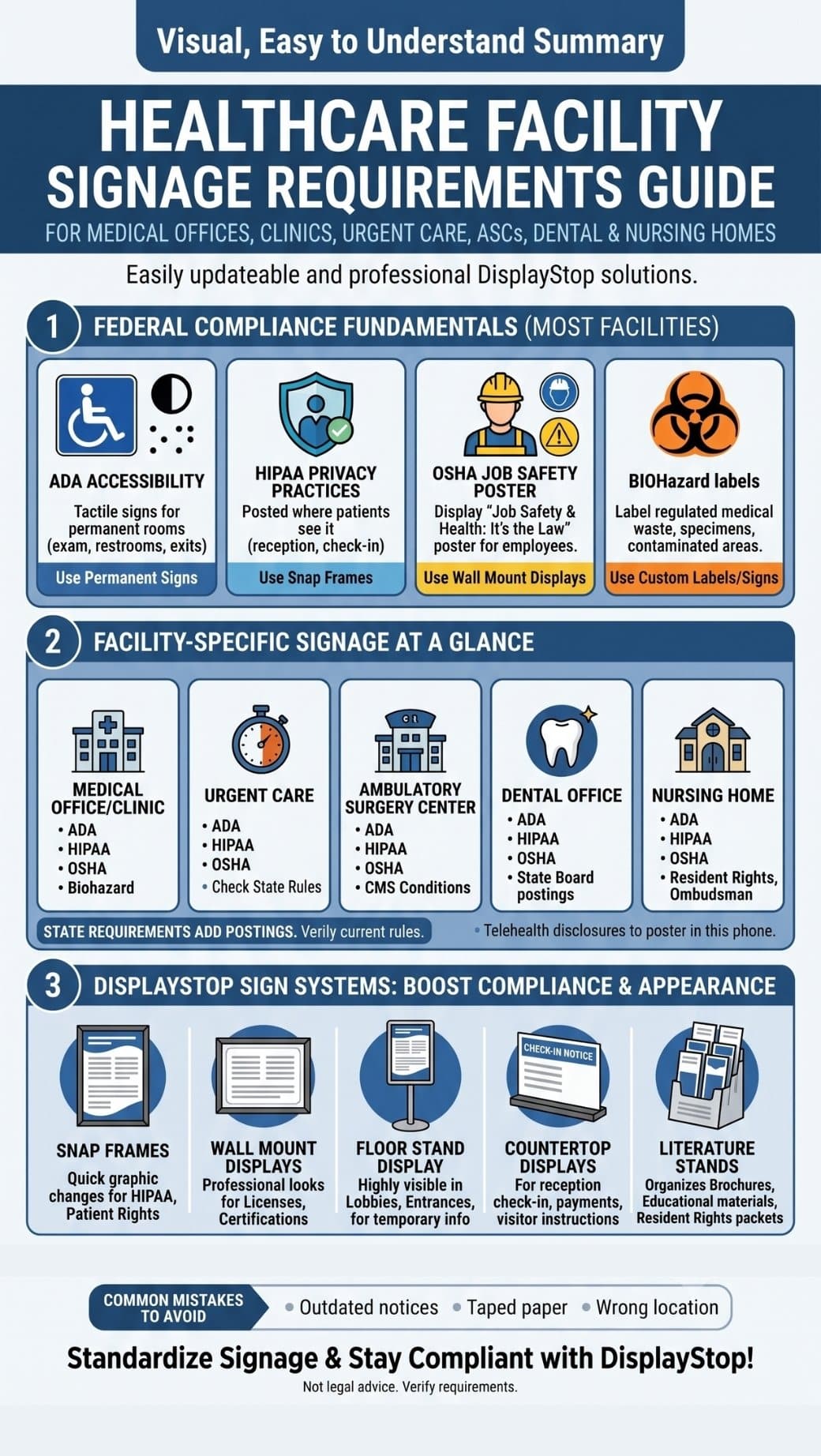
Federal Healthcare Signage Requirements That Apply to Most Facilities
Although every type of healthcare facility operates differently, several federal requirements apply across nearly all settings. These form the foundation of most healthcare signage compliance programs.
ADA Accessibility Signage
The Americans with Disabilities Act requires compliant identification signs for permanent rooms and spaces such as exam rooms, restrooms, stairwells, exits, and accessible entrances.
ADA signs must meet specific requirements for tactile lettering, Grade 2 Braille, contrast, and mounting height. If you’re looking for the complete technical specifications, see our Hospital Signage Requirements Guide, which explains ADA standards in detail.
Many facilities standardize their ADA program using permanent healthcare sign holders and wall mounted display systems, such as Snap Frames for notices that change regularly.
HIPAA Notice of Privacy Practices
Every covered healthcare provider must display its HIPAA Notice of Privacy Practices where patients can easily see it, typically near reception or check-in. Providers that maintain a website must also publish the notice online.
Because HIPAA notices are occasionally updated, utilizing healthcare sign holders with printed inserts is recommended, as signs can be replaced in seconds without purchasing an entirely new acrylic or other frame display.
OSHA “Job Safety and Health: It’s the Law” Poster
Nearly every healthcare employer covered by the Occupational Safety and Health Act must display OSHA’s official Job Safety and Health: It’s the Law poster where employees can easily see it. This requirement applies to medical offices, dental practices, outpatient clinics, nursing homes, and many other healthcare facilities.
Although this poster isn’t healthcare-specific, it is one of the most frequently overlooked workplace postings during inspections. OSHA provides the poster as a free download, but facilities should verify they are displaying the current version.
OSHA Bloodborne Pathogens & Biohazard Signage
Facilities that handle blood or other potentially infectious materials must also comply with OSHA’s Bloodborne Pathogens Standard. This applies to most physician offices, urgent care centers, laboratories, dental practices, surgery centers, and many long-term care facilities.
Regulated medical waste containers, specimen storage, refrigerators containing blood products, and designated work areas must display proper biohazard labeling. Facilities that store chemicals should also comply with OSHA’s Hazard Communication Standard for chemical labeling.
Healthcare Signage Requirements by Facility Type
After meeting the basic ADA, HIPAA, and OSHA requirements, each healthcare facility has additional regulations based on the services it provides.
Medical Offices & Outpatient Clinics
Most physician offices and outpatient clinics have one of the simplest compliance checklists. Required signage typically includes ADA room identification signs, a posted HIPAA Notice of Privacy Practices, OSHA employee postings, and biohazard labels if blood draws or specimen collection occur on site.
Most independent physician practices are not subject to EMTALA requirements. Those rules generally apply only to hospitals and qualifying emergency departments.
Medical offices often benefit from using healthcare sign holders for HIPAA notices and other frequently updated postings, while permanent ADA room signs remain fixed throughout the building.
Urgent Care Centers & Freestanding Emergency Departments
Urgent care facilities require a closer review because EMTALA does not apply equally to every location.
Hospital-owned urgent care centers that operate as a department of the hospital may qualify as a dedicated emergency department under CMS guidance. If so, EMTALA requirements, including required patient notices, may apply.
Independently owned urgent care centers generally do not fall under EMTALA, although many states require similar patient notices. Facilities should confirm their obligations with legal counsel before assuming EMTALA does or does not apply.
Large patient notices are commonly displayed near entrances using Floor Sign Stands so they remain visible to arriving patients.
Ambulatory Surgery Centers (ASCs)
Ambulatory Surgery Centers that participate in Medicare must comply with CMS Conditions for Coverage in addition to ADA and OSHA requirements.
Patient rights notices, infection control postings, and other required information should be reviewed regularly because CMS guidance and state licensing requirements may change over time.
Many ASCs choose updateable display systems that allow printed notices to be replaced without changing permanent fixtures throughout the facility.
Dental Offices
Dental offices follow many of the same federal requirements as physician practices. ADA room identification signs, OSHA workplace posters, and proper biohazard labeling all play an important role in maintaining compliance.
Most state dental boards also require practices to display current professional licenses and other patient notices. Because these requirements vary, offices should verify them directly with their state licensing board.
Reception areas often use Wall Mount Displays for licenses, patient notices, and educational materials that need a professional appearance.
Nursing Homes & Assisted Living Communities
Nursing homes and assisted living communities have additional federal requirements beyond those that apply to most outpatient facilities.
Facilities certified for Medicare or Medicaid must make resident rights information available and post contact information for the Long-Term Care Ombudsman Program and other resident advocacy organizations. State agencies often require additional postings covering grievance procedures, staffing information, and inspection results.
Many communities use Literature Stands so residents and family members can easily take copies of resident rights information, grievance forms, and educational materials.
Telehealth & Virtual Care
Healthcare organizations offering virtual care should also review state telehealth disclosure requirements. Some states require providers to disclose technology limitations, informed consent information, privacy practices, or instructions for obtaining in-person care.
Although these disclosures are not always traditional signs, many facilities display them at reception areas, patient kiosks, or digital check-in stations alongside HIPAA notices.
State Requirements Can Add Additional Signage
Federal regulations establish the minimum requirements. Individual states frequently require additional patient notices, workplace postings, language assistance information, or licensing displays.
Some states require interpreter service notices, while others mandate complaint procedures, staffing disclosures, or additional resident rights information for long-term care facilities.
Rather than relying on a generic checklist, facilities should verify current requirements with their state health department, licensing agency, or professional association before ordering new signage.
Using updateable healthcare sign holder systems such as Silhouette Aluminum Trim Frames or Snap Frames makes future updates much easier as regulations change.
Choosing the Right Sign System for Healthcare Facilities
Meeting healthcare signage requirements is only part of the equation. Facilities also need signage that is easy to update, durable enough for daily use, and professional in appearance. Choosing the right display system can reduce maintenance costs and make future compliance updates much simpler.
Snap Frames & Silhouette Aluminum Trim Frames
Snap Frames and Silhouette Aluminum Trim Frames are two of the most popular options for healthcare facilities because graphics and notices can be changed in seconds without removing the frame from the wall. They work well for HIPAA Notices of Privacy Practices, patient rights postings, visitor information, and other documents that change periodically.
The Silhouette Aluminum Trim Frames are simple to install, as no screws or drywall holes are necessary (adhesive backed).
Wall Mount Displays
Wall Mount Displays provide a clean, professional appearance for licenses, certifications, compliance notices, directories, and informational posters. Many medical offices and outpatient clinics use them throughout waiting rooms and reception areas.
Floor Sign Stands
Temporary notices often need to be placed where patients naturally enter a building. Floor Sign Stands are ideal for entrances, lobbies, emergency notifications, directional signs, and temporary compliance messaging.
Countertop Displays
Reception desks are often the first stop for patients. Countertop Displays work well for visitor instructions, payment information, patient forms, and other notices that should be visible during check-in.
Literature Stands
Facilities that provide brochures, patient education materials, resident rights packets, grievance forms, or take-home information often choose Literature Stands. They keep printed materials organized while making them easy for patients and visitors to access.
Why Updateable Signage Matters
Healthcare requirements can change. Using frames and other updateable healthcare sign holder systems allows facilities to replace printed inserts without replacing the entire sign or display.
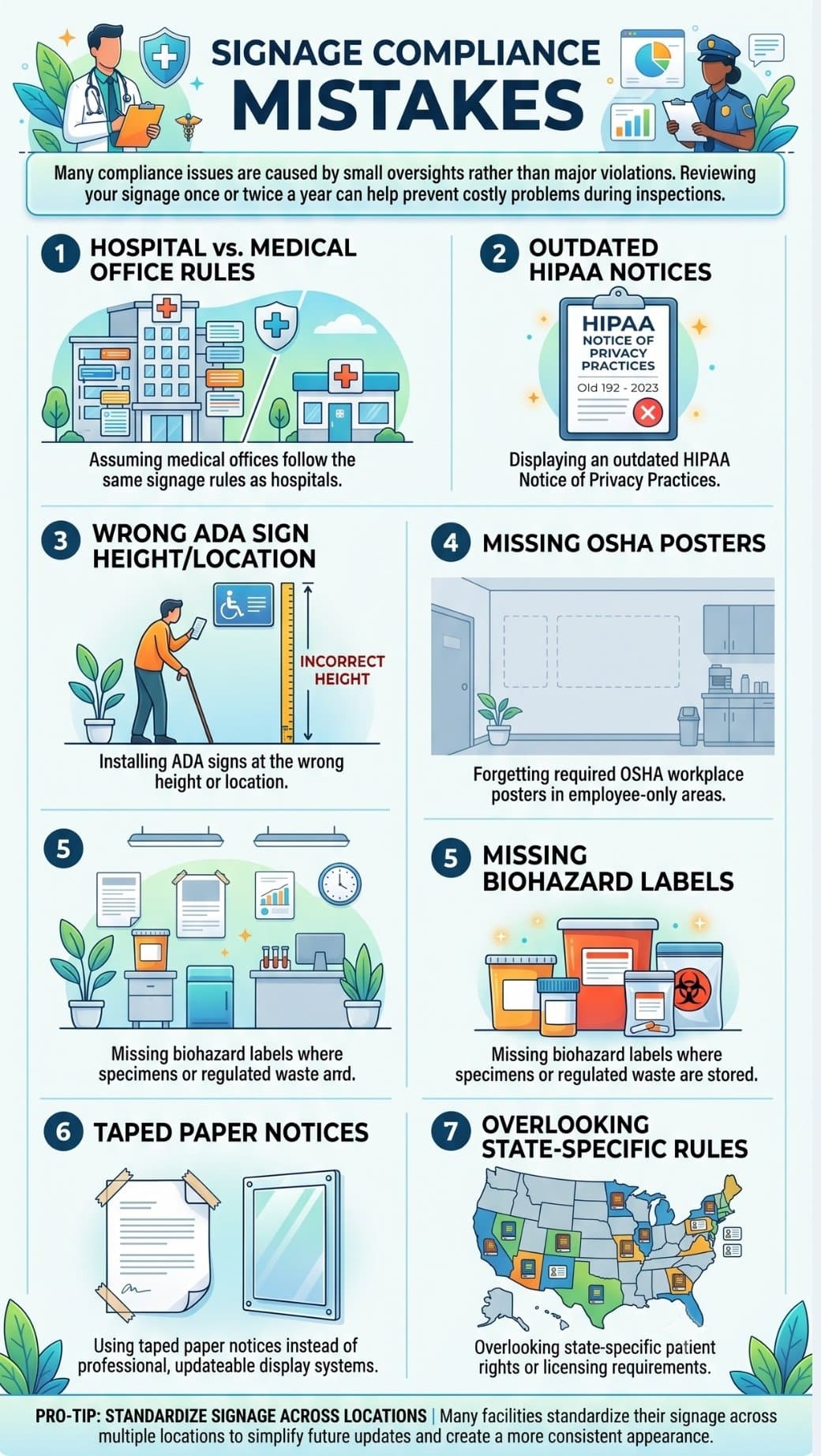
Common Healthcare Signage Requirements Compliance Mistakes
The majority of compliance issues are caused by small oversights rather than major violations. Reviewing your signage once or twice a year can help prevent costly problems during inspections.
- Assuming medical offices follow the same signage rules as hospitals.
- Displaying an outdated HIPAA Notice of Privacy Practices.
- Installing ADA signs at the wrong height or location.
- Forgetting required OSHA workplace posters in employee-only areas.
- Missing biohazard labels where specimens or regulated waste are stored.
- Using taped paper notices instead of professional, updateable display systems.
- Overlooking state-specific patient rights or licensing requirements.
Many facilities standardize their signage across multiple locations to simplify future updates and create a more consistent appearance.
Explore heavy-duty, easy-change hospital sign frames & healthcare sign holders built for high-traffic facilities.
Healthcare Signage Compliance Checklist
Use this checklist as a starting point when reviewing your facility.
- ADA-compliant signs identify permanent rooms and accessible spaces.
- HIPAA Notice of Privacy Practices is posted where patients can easily see it.
- OSHA “Job Safety and Health: It’s the Law” poster is displayed for employees.
- Biohazard labels are installed where required.
- Facility-specific federal requirements have been reviewed.
- State-required notices are current.
- Multilingual signs are provided when required.
- Sign holders allow future updates without replacing entire displays.
Requirements vary by facility type, location, and applicable federal and state regulations. Verify current requirements before implementing a compliance program.
Frequently Asked Questions
Do medical offices have to follow the same signage rules as hospitals?
No. Most medical offices must comply with ADA, OSHA, and HIPAA requirements, but hospital-specific regulations such as EMTALA generally do not apply.
Does every healthcare facility need ADA signs?
Nearly every healthcare facility must install ADA-compliant room identification signs for permanent spaces such as restrooms, exam rooms, stairwells, and accessible entrances.
Where should a HIPAA Notice of Privacy Practices be posted?
It should be displayed in a location where patients can easily see it, most commonly near the reception desk or waiting room. Providers with a website must also publish the notice online.
Do dental offices need OSHA signage?
Yes. Dental offices generally must display OSHA workplace posters and comply with bloodborne pathogen labeling requirements when applicable.
Does EMTALA apply to urgent care centers?
Sometimes. Hospital-owned urgent care centers may fall under EMTALA depending on how they operate. Independent urgent care centers generally do not, although state regulations may require similar patient notices.
What signs are required in nursing homes?
Nursing homes certified for Medicare or Medicaid must comply with federal resident rights requirements and typically must post Long-Term Care Ombudsman contact information along with additional state-required notices.
What is the easiest way to keep healthcare signage up to date?
Many facilities use updateable display systems such as Snap Frames and Wall Mount Displays. They allow printed inserts to be replaced quickly whenever regulations or policies change.
Why Healthcare Facilities Choose Display Stop
Healthcare facilities need signage that looks professional, meets regulatory requirements, and is easy to maintain. Display Stop supplies durable display products used by medical offices, hospitals, dental practices, outpatient clinics, long-term care facilities, and healthcare systems across the country.
Whether you’re updating one waiting room or standardizing signage across multiple locations, Display Stop offers solutions for nearly every application, including Snap Frames, Wall Mount Displays, Floor Sign Stands, Countertop Displays, Literature Stands, and specialized Vaccine Signage.
Using standardized display systems makes it easier to replace notices as regulations change while maintaining a consistent appearance throughout your facility.
Disclaimer
This article is provided for informational purposes only and should not be considered legal advice. Healthcare regulations vary by state and may change over time. Always verify current requirements with the appropriate federal and state agencies or your legal counsel before implementing a signage compliance program.